


Horsepal
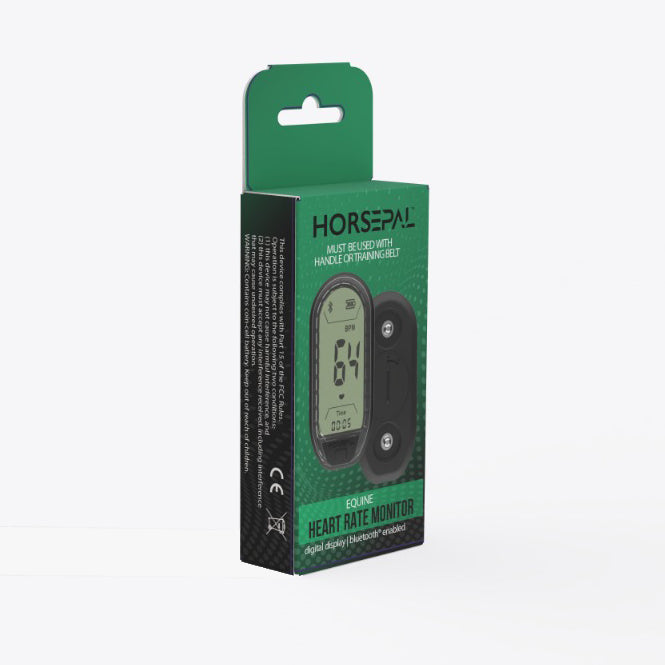
Equine Heart Rate Monitor
Equine Heart Rate Monitor
Couldn't load pickup availability
KNOW YOUR HORSE’S HEART
Your horse’s heart rate can help you monitor their health, assess their fitness, and optimize training by providing insights into their physical condition and response to exercise. Your horse’s normal resting heart rate is a vital health baseline — and it’s unique to each horse. The typical range is 28 to 44 beats per minute. A sudden increase outside their average can be an early warning sign of stress, pain, infection, colic, or other health issues. By recording your horse’s heart rate daily for a week, you’ll know their personal average resting rate, making it easier to spot changes and take action before problems escalate.
* Must be used with handle or training belt. sold separately.


Collapsible content
How do I use the Heart Rate Monitor?
The Horsepal Heart Rate Monitor is designed to give you accurate heart rate data both during rides and on the ground, so you can track fitness, recovery, and overall wellness in real time.
1. During rides (Training Belt)
Use the heart rate monitor with the training belt to track your horse’s heart rate continuously while riding. Secure the heart rate monitor to the belt or extension. Pair the device with the Horsepal app via Bluetooth. Start your ride in the app to record real-time heart rate data.
This allows you to:
• Monitor effort levels during training
• Keep your horse in the correct conditioning zones
• Track recovery immediately after work
• Analyze trends over time
2. On the ground (Handheld / Handle use)
You can also use the monitor on the ground with the handle to quickly check your horse’s heart rate at rest. Click the heart rate monitor onto the Horsepal handle. Pair the heart rate monitor via bluetooth to the app to record and store results. Wet the horse’s girth area generously and then place the handle against the horse’s side. Hold steady until a reading is captured. Use this to establish your horse’s resting baseline or spot-check changes. This information can be bluetoothed directly to the horsepal app and stored conveniently for you.
This is especially useful for:
• Daily wellness checks
• Monitoring resting heart rate
• Checking recovery after exercise
• Identifying early signs of stress or illness
Why Is Horse Heart Rate Important?
Your horse can’t tell you when something feels off—but their heart rate can. Consistent monitoring gives you a clearer picture of effort, recovery, and overall condition, helping you make smarter, more proactive decisions about training and care.
With tools like Horsepal, this data becomes easy to track, understand, and apply—whether you’re training at a high level or simply focused on keeping your horse healthy and performing at their best.
How do I use a heart rate monitor to improve my horse’s fitness and training?
Using a heart rate monitor on your horse allows you to train with precision instead of guesswork. By tracking how your horse responds to exercise and recovers afterward, you can build fitness safely, avoid overtraining, and measure real progress over time.
1. Monitor effort during your ride
• Heart rate tells you how hard your horse is actually working—regardless of how it feels.
• Use the training belt to track heart rate in real time
• Keep your horse within appropriate effort levels for your training goals
• Compare heart rate across similar rides to measure improvement
If your horse maintains the same pace or workload at a lower heart rate, fitness is improving.
2. Use recovery rate to measure fitness
• Recovery is one of the most reliable indicators of conditioning.
• After exercise, track how quickly your horse’s heart rate returns to normal
• A faster recovery = improved cardiovascular fitness
• A slower recovery can indicate fatigue, dehydration, or lack of conditioning
Tracking this consistently gives you a clear, measurable way to evaluate progress.
3. Establish training benchmarks
Every horse is different, so it’s important to build your own data set.
Track:
• Average heart rate during flatwork, jumping, or conditioning sets
• Peak heart rate during intense efforts
• Recovery time after each session
Over time, this helps you:
• Set realistic training goals
• Identify performance plateaus
• Adjust workload based on real data
4. Avoid overtraining and reduce injury risk
• Heart rate can reveal when your horse is under stress—even before you see it.
• Elevated heart rate for the same workload = possible fatigue or strain
• Slower recovery than normal = need for rest or lighter work
• Using this data helps you train smarter and protect long-term soundness.
5. Build a progressive training program
• With consistent data, you can safely increase intensity over time.
• Gradually increase workload while monitoring heart rate response
• Ensure your horse adapts before pushing further
• Balance training days with recovery days
This is especially valuable for eventing, endurance, and performance horses—but just as important for everyday riders focused on wellness.
Why it matters
Your horse’s heart rate gives you real, objective feedback on effort, fitness, and recovery. Instead of relying on feel alone, you’re making decisions based on how your horse is actually performing physiologically.
With consistent tracking, you’re not just riding. You’re training with purpose.
How do I use Heart Rate for Horse Wellness?
Heart rate isn’t just a training tool—it’s one of the earliest indicators of changes in your horse’s health and overall wellness. Subtle shifts in heart rate often appear before visible symptoms, giving you a valuable early warning system.
1. Establish a normal baseline
The first step is understanding what’s normal for your horse:
• Resting heart rate
• Typical heart rate during work
• Recovery time after exercise
Every horse is different, and consistent tracking allows you to recognize even small deviations from their norm.
2. Spot early signs of illness or stress
An elevated resting heart rate is often one of the first signs that something isn’t right.
For example:
If your horse’s normal resting heart rate is 28–32 bpm and you begin seeing consistent readings in the mid to high 30s or higher, that’s a meaningful change
When paired with a slightly elevated temperature, reduced appetite, or low energy, it may indicate the early stages of illness
In cases like Equine Herpesvirus (EHV), horses can show subtle physiological changes—like elevated heart rate—before more obvious symptoms such as fever, nasal discharge, or neurological signs appear.
Catching these early signals can make a critical difference in:
• Isolating the horse quickly
• Preventing spread within a barn
• Starting veterinary care sooner
3. Use combined data for better decisions
Heart rate becomes even more powerful when used alongside other wellness indicators:
• Heart rate + temperature
• Heart rate + behavior changes
• Heart rate + performance changes
If your horse’s heart rate is elevated at rest and their temperature is slightly above normal, it’s a strong signal that something may be developing—and it may be time to call your veterinarian.
4. Monitor recovery as a wellness check
Wellness isn’t just about illness—it’s also about how your horse handles work.
A horse that normally recovers quickly but suddenly takes longer may be:
• Fatigued
• Dehydrated
• Fighting off early illness
These changes often show up in recovery data before anything is visible.
5. Be proactive, not reactive
By consistently monitoring heart rate, you’re not waiting for obvious symptoms—you’re catching changes early.
This allows you to:
• Adjust training before stress becomes strain
• Identify potential health concerns sooner
• Make more informed decisions about care and workload
Why it matters
Heart rate gives your horse a voice when they can’t communicate discomfort or illness. Small changes—especially at rest—can be your first clue that something is off.
With consistent tracking, you’re not just training smarter—you’re protecting your horse’s health and well-being every day.
 Download on Google Play
 Download on App Store